
The Colors of Surrender
Nicolas Cheng, Eunice Leung | Art by Amber Lai
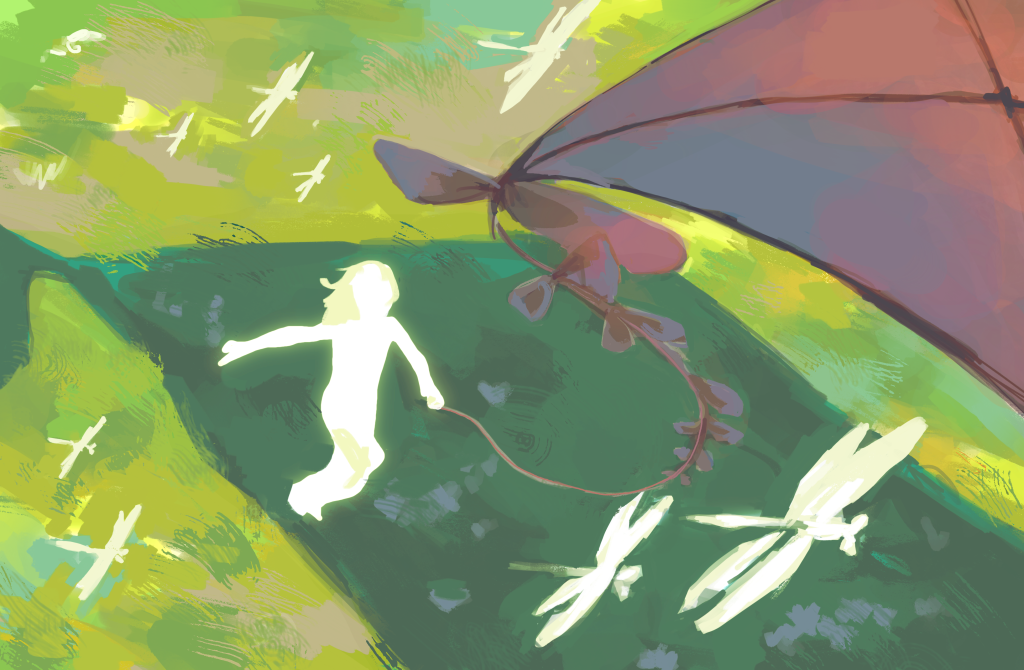
The guns had gone quiet that morning.
Nobody told her why. She was too young for explanations and too old to stop being curious, so when the door swung open in the wind, she walked through it, the kite tucked under her arm, its crimsontail dragging behind her in the mud.
She ran because that is what children do with open land. She did not see the craters or the upturned earth or the way the grass stopped growing in certain places. She saw space, and she filled it the way water fills a bowl, completely and without hesitation.
The kite went up fast. The wind here was strong and indifferent, unbothered by what the valley had witnessed. She let the string run through her small fingers and felt the pull of it, that honest upward tension, something trying to leave the earth and almost making it.
She ran along the ridge without knowing it was a ridge. The barbed wire appeared slowly, the way danger often does, first one coil half-buried in the mud, then another, then a long-rusted run of it stretching in both directions like a sentence that never ends. She stepped on the sandy colored helmets, leaking out the crimson wine colored fluid onto the soil. She slipped between two gaps without knowing she was slipping through anything at all. Her eyes were up. They were always up.
A soldier watched her from inside the skeleton of a wall.
He had been there since before dawn, holding his rifle the way a man holds something he no longer remembers picking up. The war had filled him slowly, the way sediment fills a river, until he could not see the bottom of himself anymore. He had forgotten what it felt like to want something small. To want something that did not involve surviving.
The kite crossed the sky briefly above him, and he forgot, briefly, to be afraid.
She ran past him close enough that he could hear her breathing, quick and bright, entirely unconcerned with the world as he knew it. She had not seen him. Her face was tilted up, open to the cold sky, her whole small body leaning into the pull of the string.
She stopped when she heard him. They looked at each other across a few feet of scarred earth. The kite strained above them, red against white sky, impatient ot go somewhere neither of them could follow.
Not because she understood who he was or what side of the wire he had come. Only because she was tired of holding it alone.
He crossed the broken ground and took it. He stood for a long time, a grown man in a ruined coat, holding a child’s kite on a battlefield, feeling the pull travel through his fingers and into his chest, loosening something that had been clenched there so long he had stopped noticing the ache
The red kite climbed higher. The barbed wire caught the light along the ridge below them, silver and cold and going nowhere..
He did not know the word for what he felt. He wants to let go of everything. To uncurl his hands from every terrible thing the years had pressed into them and simply let the wind drift it away. Let it rise. Let it become someone else’s place of worship.
He only knew that the kite was red, and the sky was the color of nothing in particular, and the small girl beside him was looking up with her whole heart, and for one reasonable moment, the war seemed like something that was happening very far away to someone neither of them knew.
When they found her later, she was asleep in the crook of the wall. The kite was tangled in a bare tree overhead, still pulling at its string, still trying, trying to free itself and lifting itself towards freedom.
is staying barely alive, contingent on
mechanical and medicinal maintenance, living at all?
my daring dragonfly,
you swam before learning to run.
up until the age of six months, babies have a natural instinct
to swim. they know to hold their breaths underwater.
you charged ahead, limbs loose, first in every race, faster than we could ever catch you.
my daring dragonfly,
you ran before learning to fly.
kite-flyers put them up for others just as much as themselves,
to sketch against the sky. cuffs of counterfeit constellations.
“here,” i had said, “hold it like this.” you grinned,
fingers wrapping around the string, nylon blooming behind you. ahead, you had infinite distances to decorate.
my daring dragonfly,
you flew before learning to fall.
the fastest human peaked at a sprinting speed of 28 miles per hour.
the toyota camry reached 140 when you thought you could out-chase a machine. add three: the words i wish you would have heard as your last. my hands keeping you afloat, pushing you to take off, clapping as you soared, checking your pulse — coming up empty. my hands,
mouthless, gasping around ‘i love you.’
my daring dragonfly,
you fell before learning to release.
rose had to let go of jack’s hand, intertwined in hers,
to save her own life. “i’ll never let go, i promise.”
when i found you, the string was tightly in your fist.
against the concrete, synthetic red, blue, yellow, green seemed
to glow. i tried to convince myself your wings, crooked —
snapped — were mirages of the night, too. a closed-eyed chimera.
my darling dragonfly,
you died before i could teach you to release.
to cut off one’s life support, doctors remove all the artifice from the body. no breath and no beat verified; time of death recorded.
you lay, pale, pure as birth. my fingers slide between yours. the string slips, silently, as do the streaks spilling down my face.
“let go,” i whisper. “we can swim again soon.”
my lips against your knuckles, a sliver of light streams along your back.
no. not when you were meant for seas and soil and skies.