
I Dare You
Katie Shang, Maddy Chang | Art by Jiuxi Chu
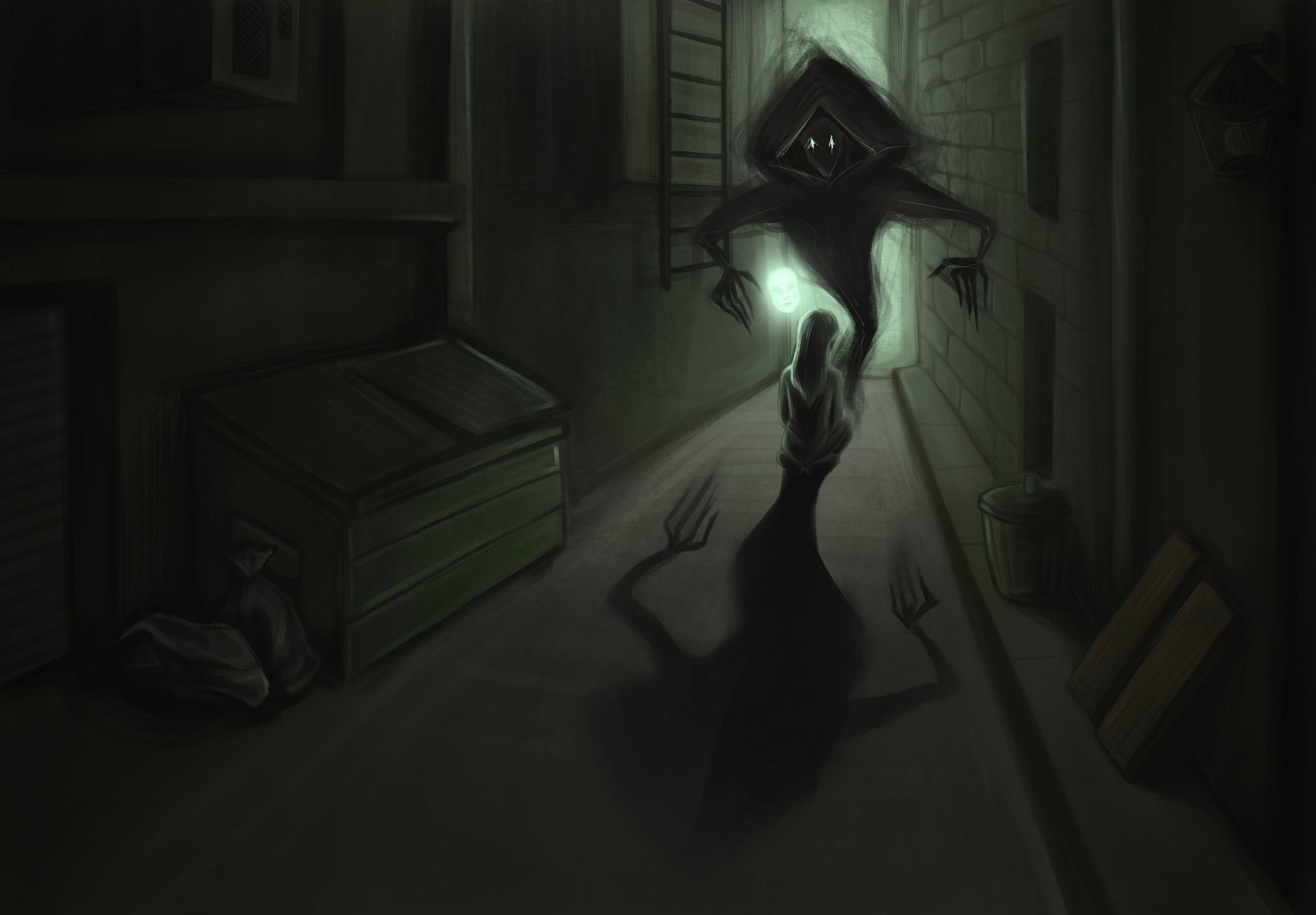
There is a Seller who lives in the darkest corner of the city—the type of neighborhood that mothers tell horror stories to their kids about, with the type of alleyways that feel just too heavy with something terrible. He’s an old man, and a dreadful one at best. His scalp is a quilt of stitched patches of skin, varying in hair, rough and torn like it’s been scorched. His flesh is the color of dust and sags off the bones like draped leather. And the worst part: he doesn’t really have eyes—just scars.
But this Seller is born of magic. He reeks of it, something otherworldly and daring. He has that kind of cloud hanging above him, a sort of questionable layer almost dancing around his body, his hands, his words. He’s got thousands of souls hanging from the belt on his hips. They’re rusted; torn apart and hammered back together. The souls look like planets in the way they come with names, colors, pieces and stories; they were born with just the right glow and temptation for humans to find it.
The Girl is scared. It’s not just the appearance of this old man that frightens her. It’s the sheerness of him. He seems to exist in some kind of other reality, between the solid ground of the Earth and the buzzing stars that mirror the city lights. He doesn’t seem to know he’s alive, or maybe he does but has no care for it. Life for the old Seller isn’t fragile; isn’t wrapped in bows and adorned with glitter and delicate hearts. Life for the Seller is worth absolutely nothing, hanging off his belt in thousands of cries.
For that is the reason the Girl seeks out to him anyway. The promise of a new soul overbears any fear. She searches for him till the skin of her feet peel and bleed, and whispers to herself the vow of her new life, just at her fingertips. And when she finally meets him, she cries.
Please take my life, the Girl says.
The Seller smiles at her. He tells her the harsh tales of devotion, of an unhealthy feeling wounded with deep knife cuts of consequence. He knows who she is. He knows of young boys and girls who have seen a terror they believe is bigger than Earth. He knows of humans who feel the sky is crushing down on them, who feel their hands cannot stop shaking and their hearts cannot stop beating no matter how hard they try. And when faced with failure, the humans come to him, crying.
But there is a fire pooling in this Girl’s chest. Take it. She begs. She falls on her scraped knees and pleads with her head kissing the floor, with her bruised fingers clawing the dirt as if digging for treasure. Make me somebody else.
The Seller brushes his hand across his belt. He mutters a chant, his fingers grazing each life that is chained to him. He stops suddenly, and scoops a soul up in his ragged arms. The Girl is surprised that he cradles it so lovingly.
He croaks out to her, hands outstretched with life splayed out in his palms, molding against each twitch of knuckle. Take it. I dare you to take it.
To take this life is to replace your own. To take this soul, the Girl knows, is to erase hers in return. The man does not sell escape. He sells conclusions, endings made from a loss of one life to the seeds of another that will flourish into a soul. It’s simple. An erase of the Girl’s shaking hands and beating heart for a body that won’t remember.
The Girl crawls up in a daze. The Seller looks her in the eye. I dare you to take it.
The soul is rumbling now in his hands. It’s enchanting. There are promises in that life that reach out and pull the Girl by the heart, chanting assurance. The Girl can almost taste how pure it would be. She only feels yearning, the wonder on how it must feel to be someone new and someone free.
The Seller can feel it too. But for a man so keen on a meaningless life, his eyes are hollow and bear a secret kind of agony. He winces. I dare you.
The Girl closes her eyes.
I dare you to reach out and take it. Take the soul that you want to replace your own so fiercely. Take the soul and lose the memories of your own. Take this soul and forget what you look like. Take this soul and forget faces, forget smile lines and crooked teeth and smiling, upturned eyes. Take this and lose every hum against your chest, every thrill your heart carries, every human that’s been welcomed against firm handshakes to tight, giggly hugs. Take this soul to forget the night sky flashing in spotlights, and the painted clouds that seep intertwined with orange, blue and pink.
I dare you to leave behind your mother’s off key lullabies and pastel toy rattles from before you can even remember. I dare you to lose tiny hands held with your own, broken chalk on the sidewalk and striped denim overalls that fit too small. Forget wrinkled faces adorned with laughs and cool wind caressing your face, sticky tears in theaters and excited messages sent with bad spelling from typing too fast. Forget your mother, your father, your sister, your brother; forget your person, your joy, your home, your place; forget yourself if it means to take a new life. I dare you to take it.
When the Girl opens her eyes, the Seller is gone. Only on the floor is the soul bound to replace her own, still alluring with its kind whispers and spells. It sits eagerly, patiently, as if waiting for the Girl scoop it up greedily.
But she only cries. She weeps for hours and hours, till she can’t breathe and her hair sticks to the wet trails on her cheek. She sobs until she knows it’s time to go, and the Girl leaves the life to seek something else in her own.
They always come bleeding.
The feet give them away at first — the sound of split skin against wet stone; a particular kind of ruined gait that only comes from walking too long toward something you’re not quite sure still exists. He hears that sound before she even rounds the corner. He had been hearing her for weeks, the way he hears all of them: a low hum in the hollow of his chest, somewhere where his eyes used to be.
He does not need eyes for this work.
The city hums its filthy hymn around him and he is part of it, threaded into the dark the way rot threads into wood. Longer than the particular shade of misery that settles into neighborhoods like this one. He knows his hands the way a man knows a scar. They’re ancient hands. Rope-veined and wrong-colored and alive with something that is not quite warmth. The souls shift on his belt as he moves, thousands of them clicking and murmuring like a rosary dragged through gravel, each one a world. Each one a name, a color, a specific quality of light that once belonged to a specific life in a specific body that woke each morning and did not know it was extraordinary for waking. He has cradled each one. He has felt the particular weight of each one, the way the best ones hum against your palms like something that has decided to trust you.
You do not forget that weight.
He does not sell what they think he sells. That is the first thing. They come to him with their wild hunger for erasure, their fantasy of the clean state, the new life unwrapped and waiting like a gift. Yet — they are not wrong that he has it. He has it by thousands, ringing rusted at his hip. But they misunderstand the translation. You do not trade up. You do not hand over a broken thing and receive something home. You hand over the broken thing and the whole thing takes its place, and what was you — the unrepeatable arrangement of grief and memory and crooked-toothed laughter that might’ve been broken but it was still yours — sinks like a stone with no water to cushion the fall.
He has watched it happen.
He has held the soul out, felt the wanting come off them in waves, felt their fingers hover, and then the pens who truly understood would flinch. The understanding itself is the cure. That is the second thing he does not tell them, because it cannot be told. It can only be arrived at.
She is young. They are always young when the sky gets too heavy, when the body becomes a house they cannot bear to live inside. He does not pity her. Pity would be an insult — pity would suggest she is less than what she is, which is a person in tremendous pain doing the most human thing there is: looking for a door.
But he is not a door. He is a mirror, held at an angle.
He lifts a soul from his belt, this one milk-colored and faintly trembling, cool against the ruin of his palms. She falls to her knees and he speaks. He dares her. He lays it all out. Not cruelly, but completely, the way a surgeon is not cruel for the incision. He names the things she would lose, one by one, and he feels each word cost him something too, some sliver of the old ache he carries in the scooped-out places where his eyes used to be. He does not know what it is. Regret, maybe. Or its cousin, that specific grief of someone who cannot take back a road they’ve walked too far down.
I dare you to take it.
He says it and means it and hopes she won’t.
The soul trembles in his ruined hands, whispering its sweet nothing promises, and the girl closes her eyes, and he waits — he has always been waiting, he will always be waiting — with the weight of a thousand unchosen lives clicking softly at his hip, each one still warm, each one never taken, each one proof of something he suspects is the whole point of all of it.
He waits.
He already knows.